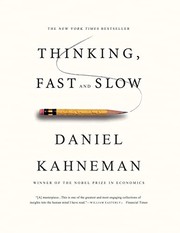
 Thinking, Fast and Slow
Thinking, Fast and Slow
Nobel laureate Daniel Kahneman maps the two systems that drive how we think. System 1 is fast, automatic, and intuitive; System 2 is slow, effortful, and deliberate. Most of the time System 1 runs the show, producing quick judgments riddled with predictable biases — anchoring, availability, overconfidence, loss aversion, and more. The book is a guided tour of these errors and how, by understanding them, we can think a little more clearly.
- Two systems run your mind
- Confident intuition is often wrong
- We feel losses more than gains
The 3 big ideas from Thinking, Fast and Slow
Two systems run your mind
System 1 is fast and intuitive; System 2 is slow and deliberate. System 1 handles most decisions automatically, which is efficient but the source of many errors.
Confident intuition is often wrong
Our fast judgments feel certain even when they're mistaken. Strong, immediate confidence is exactly the cue to slow down and engage deliberate System 2 thinking.
We feel losses more than gains
Kahneman's prospect theory shows that the pain of a loss outweighs the pleasure of an equivalent gain. This loss aversion skews countless real-world decisions.
Read the ideas free
FAQ
What is the main idea of Thinking, Fast and Slow?
That the mind runs on two systems — fast, intuitive System 1 and slow, deliberate System 2 — and that System 1's automatic shortcuts cause predictable biases in our judgment.
Is Thinking, Fast and Slow hard to read?
It's substantial and somewhat academic — around 500 pages — but written for general readers. Take it slowly; you can read it chapter by chapter rather than in one sitting.
Is Thinking, Fast and Slow worth reading?
Yes — it's the landmark work on cognitive biases by a Nobel-winning psychologist, and it reshapes how you understand your own decisions. It's dense but deeply rewarding.