Discover: one big idea at a time
On iPhone: tap Share, then Add to Home Screen.
You don't rise to your goals — you fall to your systems
James ClearShow moreYou don't rise to the level of your goals. You fall to the level of your systems.
Open as webpage →From Atomic Habits · Source: Wikipedia: Atomic Habits
Find the book on Amazon Paid link
Wealth is what you don't see
Morgan HouselShow moreWealth is what you don't see — the money kept, not spent.
Open as webpage →From The Psychology of Money · Source: Wikipedia: The Psychology of Money
Find the book on Amazon Paid link
1% better every day is 37× better in a year
James ClearShow moreGet 1% better every day, and a year later you're about 37 times better.
Open as webpage →From Atomic Habits · Source: Wikipedia: Atomic Habits
Find the book on Amazon Paid link
Focus on your Circle of Influence, not your Circle of Concern
Stephen CoveyShow moreSpend energy on your Circle of Influence — what you can affect — not your Circle of Concern.
Open as webpage →From The 7 Habits of Highly Effective People · Source: Wikipedia: The 7 Habits of Highly Effective People
Find the book on Amazon Paid link
Urgent isn't the same as important
Stephen R. CoveyShow moreMost of what feels urgent isn't important — and the important, un-urgent work is exactly what we keep postponing.
Open as webpage →From The 7 Habits of Highly Effective People · Source: Wikipedia: The 7 Habits of Highly Effective People
Find the book on Amazon Paid link
Your mind runs on two systems: fast and slow
Daniel KahnemanShow moreSystem 1 is fast, automatic, intuitive. System 2 is slow, effortful, deliberate.
Open as webpage →From Thinking, Fast and Slow · Source: Wikipedia: Thinking, Fast and Slow
Find the book on Amazon Paid link
 From our sister site Read Stacks
Meditations Chapter 2: Book 2: On the River Gran — Summary
Open on readstacks.com →Book 2: On the River Gran — a plain-English summary of Chapter 2 of Meditations by Marcus Aurelius. ~1.5-minute read, then get the book on Amazon.
Deep focus is becoming rare — and rare is valuable
Cal NewportShow moreThe ability to focus without distraction on a hard problem is becoming rare — and rare things are valuable.
Open as webpage →From Deep Work · Source: Wikipedia: Cal Newport (author)
Find the book on Amazon Paid link
Losses hurt about twice as much as gains feel good
Daniel KahnemanShow moreA loss hurts about twice as much as an equal gain feels good — so we cling, overpay, and avoid risk.
Open as webpage →From Thinking, Fast and Slow · Source: Wikipedia: Thinking, Fast and Slow
Every habit runs on a cue, routine, and reward
Charles DuhiggShow moreHabits run on a loop: cue, routine, reward. Change the routine while keeping the cue and reward.
Open as webpage →From The Power of Habit · Source: Wikipedia: The Power of Habit
The first number you hear quietly drags every guess after it
Daniel KahnemanShow moreAnchoring: the first number you see becomes a reference point that pulls all your later estimates toward it — even when it's irrelevant.
Open as webpage →From Thinking, Fast and Slow · Source: Wikipedia: Thinking, Fast and Slow
Build the smallest thing that tests your biggest assumption
Eric RiesShow moreShip the smallest thing that tests your biggest assumption, then build-measure-learn.
Open as webpage →From The Lean Startup · Source: Wikipedia: The Lean Startup
We feel obliged to give back — the rule of reciprocity
Robert CialdiniShow moreA gift creates an almost automatic obligation to give back. That pull is the rule of reciprocity.
Open as webpage →From Influence · Source: Wikipedia: Influence
A growth mindset turns failure into feedback
Carol DweckShow moreAbility isn't fixed — it grows with effort. How you see that changes everything.
Open as webpage →From Mindset · Source: Wikipedia: Carol Dweck (author)
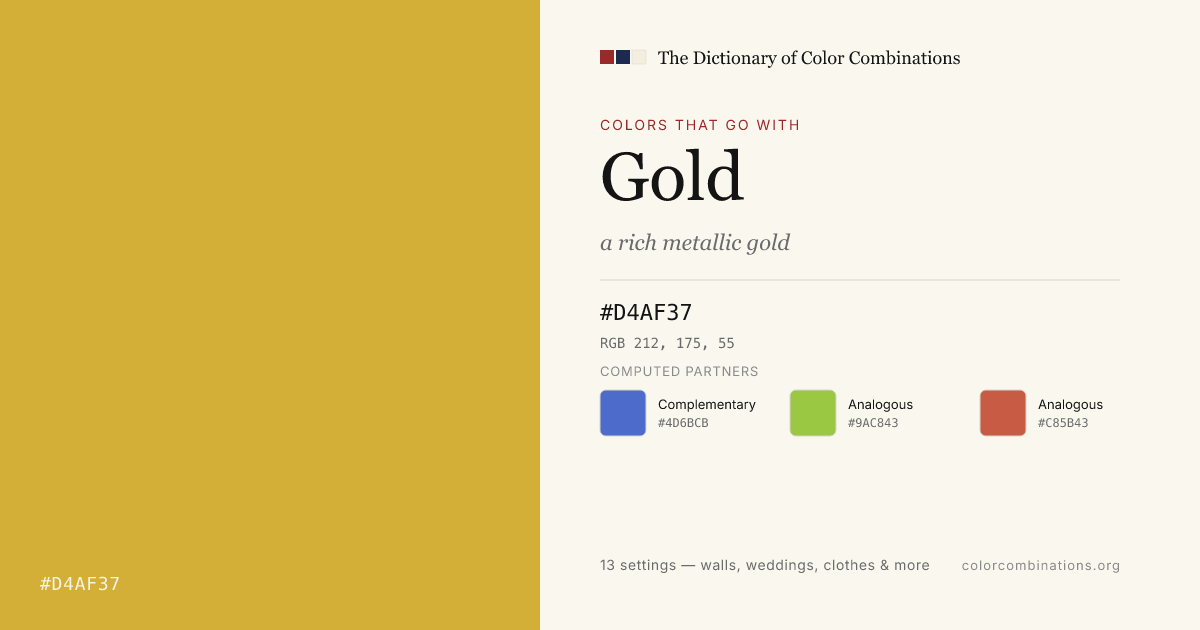 From our sister site The Dictionary of Color Combinations
Colors That Go With Gold — Pairing Guide by Room & Use
Open on colorcombinations.org →What colors go with gold? Mostly terracotta & clay or deep charcoal, with slate & blue (#4d6bcb) for contrast.
People don't buy what you do — they buy why you do it
Simon SinekShow morePeople don't buy what you do; they buy why you do it. Start with why.
Open as webpage →From Start With Why · Source: Wikipedia: Start with Why
Grit — passion plus perseverance — often beats talent
Angela DuckworthShow moreSustained passion and perseverance — grit — often predicts success better than raw talent.
Open as webpage →From Grit · Source: Wikipedia: Angela Duckworth (author)
Social proof: we copy what others do, especially when unsure
Robert CialdiniShow moreSocial proof: when we're uncertain, we decide what's correct by looking at what other people are doing — we treat the crowd's behavior as evidence about how to act.
Open as webpage →From Influence · Source: Wikipedia: Influence
Some things gain from disorder — that's antifragile
Nassim Nicholas TalebShow moreBeyond fragile and robust lies antifragile: things that gain from stress and disorder.
Open as webpage →From Antifragile · Source: Wikipedia: Antifragile
Flow happens when challenge meets skill
Mihaly CsikszentmihalyiShow moreFlow — total, timeless absorption — appears when a challenge perfectly matches your skill.
Open as webpage →From Flow · Source: Wikipedia: Mihaly Csikszentmihalyi (author)
The obstacle in your path becomes the path
Ryan HolidayShow moreWhat stands in the way becomes the way. The obstacle is the path.
Open as webpage →From The Obstacle Is the Way · Source: Wikipedia: The Obstacle Is the Way
Commitment & consistency: small yeses lock you into big ones
Robert CialdiniShow moreCommitment and consistency: once we make a commitment — even a small one — we feel internal and social pressure to behave consistently with it, which makes the next, bigger ask much harder to refuse.
Open as webpage →From Influence · Source: Wikipedia: Influence
 From our sister site VisitWhen
Bryce Canyon in December: Weather (37°/17°F) & Crowds
Open on visitwhen.com →Bryce Canyon weather in December: highs 37°F, lows 17°F, 1.3″ precipitation, 9.6h daylight. Crowds 17% of peak — a quiet month with trade-offs.
Do less, but better — the disciplined pursuit of essential
Greg McKeownShow moreDon't do more things. Do fewer, better things — the disciplined pursuit of less.
Open as webpage →From Essentialism · Source: Wikipedia: Greg McKeown (author)
Vulnerability is courage, not weakness
Brené BrownShow moreVulnerability — being seen without guarantees — is the birthplace of courage and connection.
Open as webpage →From Daring Greatly · Source: Wikipedia: Daring Greatly
Rare, unpredictable events shape history most
Nassim Nicholas TalebShow moreHistory is dominated by rare, unpredictable, high-impact events we only explain after the fact.
Open as webpage →From The Black Swan · Source: Wikipedia: The Black Swan
Judge decisions by their quality, not their outcome
Annie DukeShow moreJudge a decision by its quality at the time, not by how it happened to turn out.
Open as webpage →From Thinking in Bets · Source: Wikipedia: Annie Duke (author)
We're irrational — but in predictable ways
Dan ArielyShow moreWe're irrational in consistent, predictable ways — like judging value by comparison, not absolutes.
Open as webpage →From Predictably Irrational · Source: Wikipedia: Predictably Irrational
More choices can make you less happy
Barry SchwartzShow moreMore options can mean less satisfaction — paralysis, regret, and impossibly high expectations.
Open as webpage →From The Paradox of Choice · Source: Wikipedia: The Paradox of Choice
The Lindy effect: the longer something has lasted, the longer it will last
Nassim Nicholas TalebShow moreThe Lindy effect: for non-perishable things like ideas, books, and technologies, every extra year they've survived predicts roughly another year of life. What's lasted is likely to keep lasting.
Open as webpage →From Antifragile · Source: Wikipedia: Antifragile
 From our sister site Time Well Read
Was 'Robert Capa' invented as a fake photographer?
Open on timewellread.com →Yes, and the man who used the name wasn't even the one who first sold the pictures. Endre Friedmann, a Hungarian Jewish photojournalist, and his partner…
You have power over your mind, not outside events
Marcus AureliusShow moreYou have power over your mind, not over outside events. Realize this, and you find strength.
Open as webpage →From Meditations · Source: Wikipedia: Meditations
The planning fallacy: why everything takes longer than you think
Daniel KahnemanShow moreThe planning fallacy: we systematically underestimate how long tasks will take and how much they'll cost — even when we've been burned by the exact same thing before.
Open as webpage →From Thinking, Fast and Slow · Source: Wikipedia: Thinking, Fast and Slow
The IKEA effect: we overvalue what we build ourselves
Dan ArielyShow moreThe IKEA effect: we place a disproportionately high value on things we partially created ourselves — the labor we invest makes the result feel more valuable than it objectively is.
Open as webpage →From Predictably Irrational · Source: Wikipedia: Predictably Irrational
Did you find what you were looking for?
Not quite? Tap what was off:
Thank you. We read every answer, and pages get fixed from what readers tell us.