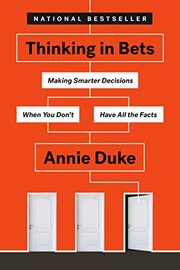
 Thinking in Bets
Thinking in Bets
Former professional poker champion Annie Duke argues that good decision-making means treating decisions as bets under uncertainty. Because outcomes are shaped by both skill and luck, a good decision can still turn out badly and vice versa — so judging decisions only by results ('resulting') is a trap. By thinking in probabilities, separating decision quality from outcomes, and seeking honest feedback, we can make better choices in an unpredictable world.
- Decisions are bets under uncertainty
- Don't judge decisions by outcomes alone
- Seek truth, not comfort
The 3 big ideas from Thinking in Bets
Decisions are bets under uncertainty
Every choice is a bet on an uncertain future, made with incomplete information. Framing decisions this way forces you to think in probabilities rather than false certainties.
Don't judge decisions by outcomes alone
Duke calls judging decision quality purely by results 'resulting.' Because luck plays a role, a good decision can lose and a bad one can win — separate the two.
Seek truth, not comfort
Improving means actively looking for honest feedback and disconfirming evidence, ideally with a trusted truth-seeking group, rather than protecting your ego.
Read the ideas free
FAQ
What is the main idea of Thinking in Bets?
That good decisions should be treated as bets under uncertainty, judged by their quality and reasoning rather than their outcomes, since luck influences every result.
What does 'resulting' mean?
Duke's term for the mistake of evaluating a decision's quality based solely on how it turned out. Because of luck, good decisions can fail and bad ones can succeed.
Is Thinking in Bets worth reading?
Yes if you want to make better decisions under uncertainty. It's short, practical, and draws memorably on the author's poker career to teach probabilistic thinking.